
People usually become interested in Bazi when they are looking for clarity.
Sometimes it starts with career questions. Sometimes it is about relationships, money, timing, or the feeling that certain patterns keep repeating no matter how hard they try to change them.
Bazi can be helpful because it gives those patterns a language.
It does not tell you that your life is fixed forever. It does not mean you have no choice. I see Bazi more as a map — not a map that controls you, but one that can help you understand the terrain you are walking through.
A map still requires you to choose where to go. But it can make the road less confusing.
What Does Bazi Mean?
Bazi means “eight characters.”
These eight characters come from your birth year, month, day, and hour. Together, they create what is often called the Four Pillars of Destiny.
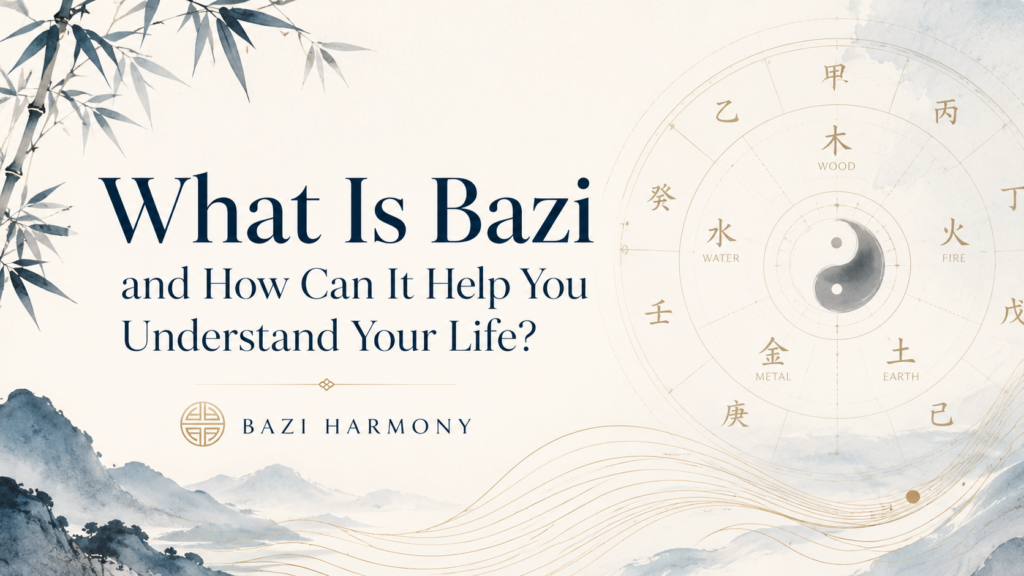
Each pillar has two parts: a Heavenly Stem and an Earthly Branch. These are connected to Yin and Yang, the Five Elements, the seasons, and cycles of time.
The Five Elements are:
- Wood
- Fire
- Earth
- Metal
- Water
At first, this can sound abstract. But in practice, a Bazi chart is used to understand the energetic pattern a person was born with.
It can show how a person naturally responds to life, what supports them, what drains them, and what kinds of themes may repeat over time.
Bazi Is Not Just a Personality Test
It is easy to think of Bazi as a personality system, but it is more layered than that.
A personality test may say, “You are this type of person.”
Bazi looks more at relationships between energies. It asks things like:
What is strong in the chart?
What is weak or missing?
What kind of environment supports this person?
What type of pressure creates growth?
What type of pressure creates exhaustion?
How does timing affect the expression of the chart?
That is why two people can have similar traits but very different life patterns. Bazi is not only about traits. It is about structure, balance, timing, and interaction.
What Can Bazi Show?
A Bazi chart can be used to explore many areas of life, including:
- natural strengths
- emotional tendencies
- career direction
- relationship patterns
- money habits
- health tendencies from an energetic perspective
- periods of change or pressure
- supportive and challenging timing
This does not mean the chart gives one fixed answer for every question.
For example, Bazi may not say, “You must become this exact profession.” But it may show whether someone is more suited to structure, creativity, analysis, leadership, communication, healing, research, business, or independent work.
It can also show whether a person may need stability, freedom, visibility, quiet focus, intellectual stimulation, or emotional security in order to function well.
That kind of information can be very useful when someone is trying to make better life decisions.
Bazi and Self-Understanding
One of the most valuable parts of Bazi is that it can help people stop fighting themselves.
Many people spend years trying to become someone they are not. They may force themselves into a career, relationship style, or lifestyle that looks good from the outside but feels wrong internally.
Bazi can help explain why.
Some people are naturally more independent. Some need structure. Some need time alone to think. Some need movement and variety. Some are deeply sensitive to their surroundings. Some are built for steady long-term effort, while others work better in waves of inspiration and action.
None of these patterns are “better” or “worse.” They simply need to be understood.
A good Bazi reading should not make you feel boxed in. It should help you recognize what is natural for you and where you may be using your energy in a way that constantly works against your own design.
Bazi and Career Direction
Career is one of the most common reasons people look into Bazi.
This makes sense. Work takes so much of our energy, and choosing the wrong path can affect almost every part of life.
Bazi can help show what kind of work themes may be more supportive. Some charts are more suited to analysis, finance, management, systems, planning, or technical work. Others may lean toward communication, beauty, teaching, healing, writing, strategy, advising, entrepreneurship, or creative work.
But I do not think Bazi should be used in a simplistic way, such as saying, “This chart means you must be a doctor,” or “This chart means you must own a business.”
Real life is more complicated than that.
A better use of Bazi is to ask:
What type of work environment supports this person?
Do they need independence or clear structure?
Are they more suited to visible leadership or behind-the-scenes expertise?
Do they do better with people, systems, ideas, research, service, or creation?
What kind of pressure motivates them, and what kind of pressure breaks them down?
These questions are much more useful than trying to force a chart into one perfect job title.
Bazi and Relationships
Bazi can also give insight into relationship patterns.
It may show how a person gives and receives support, how they respond to pressure, what kind of partner dynamic they may attract, and where misunderstandings may happen.
Some people need emotional steadiness. Some need personal space. Some need intellectual connection. Some need loyalty and clear roles. Others feel trapped when there is too much control or expectation.
A chart can also show why two people may react very differently to the same situation.
One person may see silence as peace. Another may experience it as distance. One person may show love through practical support. Another may need words, attention, or emotional reassurance.
Bazi does not replace communication, maturity, or personal responsibility. But it can create more understanding.
And sometimes understanding is the first step toward compassion.
Bazi and Timing
Another important part of Bazi is timing.
In Chinese metaphysics, time has quality. Different years, months, and life cycles bring different kinds of energy. Some periods may support action, visibility, relationships, study, career growth, or financial development. Other periods may feel slower, heavier, more internal, or more unstable.
This does not mean you should wait passively for a perfect year.
There is no perfect year.
But timing can help you understand the season you are in.
If a period supports learning, it may be better for study, preparation, healing, or planning. If a period supports action, it may be better for launching, applying, presenting, moving, or making bold decisions.
Good timing does not guarantee success. Difficult timing does not guarantee failure.
But awareness of timing can help you use your energy more wisely.
Is Bazi Fortune-Telling?
Some people describe Bazi as fortune-telling, but I think that word can be misleading.
If fortune-telling means “someone tells you exactly what will happen and you have no choice,” then that is not how I would approach Bazi.
A more practical way to see it is this:
Bazi is a symbolic system for understanding patterns, tendencies, and timing.
It can show possibilities. It can show areas of strength and challenge. It can show when certain themes may become more active. But it should not take away your free will or make you afraid of your life.
A helpful reading should leave you with more clarity, not more fear.
The best question is not always:
“What will happen to me?”
A better question is:
“What pattern am I working with, and how can I make wiser choices from here?”
What Bazi Cannot Do
Bazi is useful, but it should not be treated as a replacement for everything else.
It does not replace practical planning.
It does not replace medical care.
It does not replace communication in relationships.
It does not replace skill-building, effort, or common sense.
A chart can show potential, but potential still needs to be developed.
A chart can show timing, but timing still needs action.
A chart can show relationship tendencies, but people still need honesty, boundaries, and emotional maturity.
This is why I prefer a grounded approach to metaphysics. The chart can give insight, but life still has to be lived.
How I Like to Approach Bazi
For me, Bazi is most useful when it becomes practical.
Not dramatic. Not scary. Not fatalistic.
Practical.
A good Bazi reading should help connect the chart to real life questions:
Why does this type of work drain me?
Why do I keep attracting similar relationship dynamics?
Why do I feel stuck during certain periods?
What strengths am I overlooking?
What kind of decisions fit my nature better?
What timing may support change, planning, or rest?
Chinese metaphysics can be very deep, but it should not be used to overwhelm people. It should help life feel a little more understandable.
That is the purpose of Bazi Harmony: to make Bazi, Qi Men, and Feng Shui easier to understand and more useful in everyday life.
The Real Value of Bazi
Bazi is not about becoming someone else.
It is about understanding the pattern you already carry.
When used wisely, Bazi can help you stop forcing yourself into paths that do not fit your nature. It can help you see your strengths more clearly, understand your challenges with more compassion, and make decisions with better timing and awareness.
A Bazi chart will not live your life for you.
But it can offer a map.
And sometimes, having a map is enough to make the next step feel less confusing.
Want to Learn More?
Explore the Bazi Harmony blog for practical insights on Bazi, Qi Men, Feng Shui, timing, and Chinese metaphysics for real life.