
If you are new to Chinese metaphysics, the names can blur together very quickly.
Bazi, Qi Men Dun Jia, Feng Shui — they all sound ancient, complex, and maybe a little intimidating. They are often mentioned together, and sometimes people use them as if they are all the same thing.
But they are not the same system.
The easiest way to understand the difference is this:
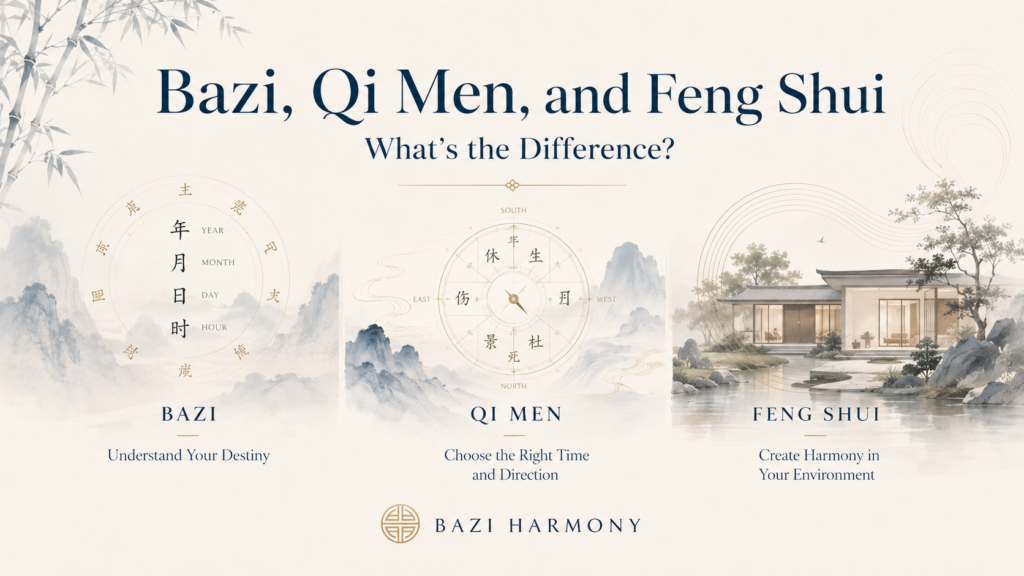
Bazi looks at the person.
Qi Men looks at the moment.
Feng Shui looks at the space.
That simple distinction already makes the whole subject much easier to understand.
Bazi can help you understand your personal pattern, strengths, tendencies, and life direction. Qi Men can help with timing, strategy, and decision-making. Feng Shui looks at the environment around you and how a space may support or weaken certain areas of life.
They can be used separately, but together they create a fuller picture: who you are, what moment you are in, and how your surroundings may be influencing you.
What Is Bazi?
Bazi, also known as the Four Pillars of Destiny, is based on your birth year, month, day, and hour.
These four parts create a chart that reflects the energetic pattern present at the moment of birth. In traditional Chinese metaphysics, this chart is built using Heavenly Stems and Earthly Branches, which are connected to Yin and Yang, the Five Elements, and cycles of time.
That may sound complicated at first, but the practical purpose is simple: Bazi helps you understand your natural pattern.
A Bazi chart can show themes such as:
- your strengths and challenges
- emotional tendencies
- relationship patterns
- career direction
- work style
- money patterns
- timing of different life phases
I do not see Bazi as something that should make a person feel trapped. A chart is not a prison sentence. It is more like a map.
A map does not walk the road for you, but it can help you understand the road better.
Bazi can be useful when you keep asking questions like:
Why do certain types of work drain me?
Why do I repeat the same relationship patterns?
What kind of environment supports me?
What strengths am I not using enough?
What kind of direction actually fits me?
In simple terms, Bazi helps answer:
What kind of person am I, and what patterns am I working with?
What Is Qi Men Dun Jia?
Qi Men Dun Jia is different from Bazi because it is more focused on timing, strategy, and the hidden dynamics of a situation.
While Bazi begins with your birth chart, Qi Men can be used for a specific moment. A Qi Men chart may be created for a question, a decision, a meeting, a move, a launch, or another important situation.
Qi Men is often used when you are not just asking “Who am I?” but rather:
What is happening right now?
Is this a good time to act?
What direction is more supportive?
What is hidden in this situation?
Should I move forward, wait, adjust, or avoid?
This makes Qi Men especially useful for decision-making.
For example, someone may ask whether they should take a new opportunity, contact a person, launch a project, move forward with a plan, or wait. A Qi Men chart can help show the quality of the moment and the strategy that may work better.
Qi Men is not only about prediction. It is also about approach.
Sometimes the answer is not “yes” or “no.” Sometimes the answer is: move slowly, change direction, gather more information, avoid direct confrontation, act quickly, or choose a different path.
In simple terms, Qi Men helps answer:
What is happening now, and what is the best way to approach it?
What Is Feng Shui?
Feng Shui focuses on the environment.
It looks at how the energy of a space affects the people living or working there. This can include a home, office, bedroom, entrance, desk placement, room layout, directions, landform, and the flow of Qi through a space.
Many people think Feng Shui is only about lucky objects, crystals, coins, frogs, or decorations. That is the popular version, but classical Feng Shui is much deeper than that.
Real Feng Shui is not just about putting a symbol in the corner and expecting life to change overnight. It studies how a space is structured, how energy enters and moves, and how the environment interacts with time and the people who use the space.
Feng Shui may be used to support areas such as:
- rest and health
- emotional stability
- relationships
- career opportunities
- financial flow
- focus and productivity
- harmony in the home
A space can feel supportive, heavy, chaotic, stagnant, exposed, or nourishing. Sometimes people can feel this before they can explain it.
Of course, Feng Shui is not magic in the cartoon sense. It does not replace effort, planning, communication, or common sense. But the environment does matter. Anyone who has tried to work in a noisy, cluttered, uncomfortable space already understands this on a practical level.
In simple terms, Feng Shui helps answer:
How does my environment support or weaken me?
How They Work Together
Bazi, Qi Men, and Feng Shui each look at life from a different angle.
Bazi shows the person.
Qi Men shows the moment.
Feng Shui shows the space.
This is why they can work together so well.
For example, imagine someone feels stuck in their career.
Bazi may show that this person is naturally suited for analytical work, independent study, healing, research, strategy, writing, business, or structured systems. It may also show whether they need more freedom, stability, creativity, authority, or quiet focus.
Qi Men may help with a specific decision: Should they apply for a job now? Should they wait? Should they contact someone? Should they launch a service? Should they choose one opportunity over another?
Feng Shui may look at whether their home or work environment supports focus, visibility, rest, or financial stability.
Each system gives a different layer of information.
One layer may show personal nature.
Another layer may show timing.
Another may show environmental influence.
Together, they can create a more complete picture.
Which System Should You Start With?
If you are completely new, Bazi is usually the best place to start.
Bazi gives you a foundation. It helps you understand your own pattern before you start looking at timing or environment. Without self-understanding, it is easy to chase advice that sounds good but does not actually fit your nature.
Start with Bazi if you want to understand yourself better.
Start with Qi Men if you have a specific question or decision.
Start with Feng Shui if your home, office, or environment feels like part of the problem.
A simple way to remember it:
Bazi: Who am I?
Qi Men: What should I do in this situation?
Feng Shui: How is my space affecting me?
A Practical Example
Let’s say someone is asking, “Should I start a business or stay in a job?”
A Bazi reading may show whether this person naturally prefers independence or structure, whether they are suited to business, whether they need stability first, or whether they may struggle with too much uncertainty.
A Qi Men chart may help look at the timing of the decision. Is this a good moment to act? Is the opportunity strong? Is something hidden? Is the better strategy to move forward, prepare quietly, or wait?
Feng Shui may show whether the person’s workspace supports focus and productivity, or whether their environment feels scattered and draining.
The same question becomes much richer when viewed through all three systems.
Instead of giving a flat answer like “yes, start a business” or “no, stay employed,” Chinese metaphysics can help explore the pattern more carefully.
That is where these systems are most useful — not as dramatic fortune-telling, but as tools for understanding.
What Chinese Metaphysics Is Not
Chinese metaphysics should not be used to scare people.
It should not make you feel doomed by your chart, afraid of a year, or dependent on someone else for every decision.
A good reading should bring more clarity, not more fear.
I also do not believe these systems should replace practical action. If a chart shows good timing, you still have to take steps. If a space has supportive Feng Shui, you still have to make choices. If a Bazi chart shows talent, that talent still needs to be developed.
The value of these systems is not that they remove responsibility.
The value is that they help you see the pattern more clearly.
Final Thoughts
Bazi, Qi Men, and Feng Shui are different systems, but they can support each other beautifully.
Bazi helps you understand your personal pattern.
Qi Men helps you understand timing and strategy.
Feng Shui helps you understand the influence of your environment.
Together, they show the relationship between person, time, and space.
Used wisely, they can help you make better decisions, understand your life patterns, and stop forcing yourself into paths that do not fit your nature.
At Bazi Harmony, the focus is practical Chinese metaphysics for real life — not fear, superstition, or dramatic predictions, but grounded insight that helps life feel a little more understandable.
Want to Learn More?
Explore the Bazi Harmony blog for practical insights on Bazi, Qi Men, Feng Shui, timing, and Chinese metaphysics for everyday life.